





Huaneng Design Institute
Design consulting EPC general contracting project supervision and other whole process professional service institutions
Replacement Fuel for Thermal Power Plant --- Roasted Biomass
(I) Foreword
The transformation of coal-fired thermal power plants into biomass power plants not only meets the requirements of the country to build a resource-saving society, achieves the strategic goals of energy conservation and emission reduction, obtains national incentive policy funding support, but also saves a lot of construction investment and improves the economic benefits of power plants. It will also increase the income of residents in the area near the power plant and maintain the employment of the original power plant workers, which has significant economic, environmental and social benefits. The problem is that if we continue to use ordinary biomass as fuel, both economically and technically, there are unsatisfactory drawbacks. The development of biomass fuels for thermal power plants with better performance has become a hot spot in the field of biomass energy in China and even in the world.
Disadvantages of (II) common biomass
(1) Coking corrosion
Compared with coal, the content of alkaline components (especially alkali metal K) in biomass ash is high, and it mainly exists in the form of active components. It is easy to volatilize in the flame and then condense on the heating surface to form slagging and ash.
(2) Storage and transportation
Because biomass fuel has low energy density, high moisture content, strong hydrophilicity and fibrous soft and flexible materials, it has a great influence on its transportation, storage and preparation. The energy density of biomass is about 1/10 that of coal, which means that when 10% biomass is co-fired by heat, its volume is equivalent to that of coal.
(3) Moisture
High moisture can affect the ignition of organisms, which in turn leads to an increase in unburned carbon, so biomass fuels should be kept dry. The biomass fuel is pre-dried before grinding and entering the furnace, which will increase the operating cost, which is one of the main factors affecting the economy of the power plant.
(4) Powder preparation
Biomass is a tough fibrous material. Compared with coal, grinding and preparation requires more energy, especially when the particle size is very small, so there is a balance between particle size and energy consumption. Usually, the range of biomass particles is recommend 1-3mm. For specific engineering cases, the most economical and reasonable particle size should be determined according to the specific conditions of fuel type, shape, moisture, combustion system, etc.
Biomass is mixed with coal in the upstream of the coal feeder, pulverized together and then sprayed into the furnace for combustion. It is the most economical, direct and commonly used mixed combustion method, and it is almost unnecessary to invest in new and modified equipment. The original coal mill pulverizing system of the power station is used to send coal and biomass fuel together into the coal mill for pulverizing. During operation, attention should be paid to the characteristics of the coal mill current, outlet air temperature and other characteristics, and the lower mixed combustion ratio should be strictly controlled to avoid the biomass fuel blocking the coal mill and causing the coal mill to malfunction.
(5) Burndown rate
Biomass particles that are large rather than spherical can have an impact on the burnout rate. After grinding, the biomass particles are longer columns rather than the approximate spherical shape of coal powder, and the density is very low, which may affect the pneumatic transportation of fuel. Such particles are not easily entrained by the gas stream into the center of the flame, thus affecting its heating and burning rate. Burnout will likely become a problem when the particle size is greater than 3mm. Therefore, when more biomass is blended, such as the mass ratio of 10%, the boiler efficiency is reduced by about 0. 5%.
(III) torrefied biomass
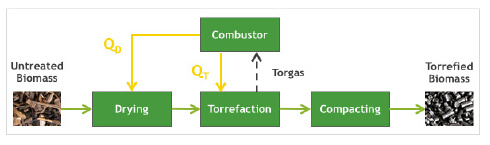
Torrefaction (Torrefaction) refers to the heat treatment technology of biomass at a temperature of 200 to 300°C in an oxygen-deficient environment, and has similar properties to charcoal. But the biggest difference between baked products and charcoal is the composition of the volatiles remaining in the product. In the manufacturing process, almost all of the volatile matter is evaporated, resulting in unnecessary energy loss. Conversely, baking can leave most of the volatiles in the product.


Comparison of (IV) torrefied biomass and ordinary biomass
(1) Based on the physical and chemical properties of the torrefied biomass and the mixed combustion ratio of coal can be increased to more than 80% without affecting the normal operation of the boiler, and it is not easy to produce coking and corrosion.
(2) The use of roasted biomass in power plants will greatly reduce costs. There is no need to add special biomass processing equipment (such as coal mills, silos, coal feeders, burners), torrefaction particles, higher volume energy density, miniaturization of process equipment, and saving equipment investment.
(3) transportation costs, especially baking particles, volume energy density, is 1.5-2 times the ordinary wood particles. It can reduce a lot of transportation costs.
(4) torrefied biomass, hydrophobic, not due to rain wet expansion, deterioration, mold, easy to transport and outdoor storage.
(5) The roasted biomass has excellent pulverizability and energy consumption is far lower than that of ordinary biomass, which greatly reduces the cost of pulverization. In addition, it can form uniform spherical particle powder with excellent fluidity. It can be mixed with coal in the upstream of the coal feeder of the existing power plant, pulverized together and sprayed into the furnace to burn and generate electricity.
It can be seen that torrefied biomass has obvious advantages over ordinary biomass for power generation fuel.
(V) for coal-fired power plants
The transformation of coal-fired power plants into biomass power plants with ordinary biomass as fuel requires the transformation of boilers, fuel storage, transportation, crushing and feeding systems, ash removal systems, dust removal systems and other systems or the addition of new equipment. Even small power plants with a scale of about 20MW will require hundreds of millions of investment, and after operation, raw material storage and equipment maintenance will increase additional costs. The use of roasted biomass as fuel, because of its performance close to coal, can be mixed with coal upstream of the existing power plant coal feeder, pulverized together and injected into the furnace combustion power generation, almost no new and modified equipment, saving a lot of construction funds and operating management costs.
It can be said that the use of roasted biomass as fuel makes the transformation of coal-fired thermal power plants more realistic and operable technically and economically.
Latest developments


Address: Floor 10, 18, 19 and 20, East Building, Building 1, Shun Tai Square, 2000 Shun Hua Road, High-tech Zone, Jinan City


